By the VixQR team · published on · 9 min read
A Short History of the QR Code: From a Toyota Factory to Your Pocket
Invented in 1994 by Masahiro Hara to track car parts, the QR code waited 25 years to take off. The story of a patent its owner chose never to charge for.
There's one detail in this story that stops me every time I think about it.
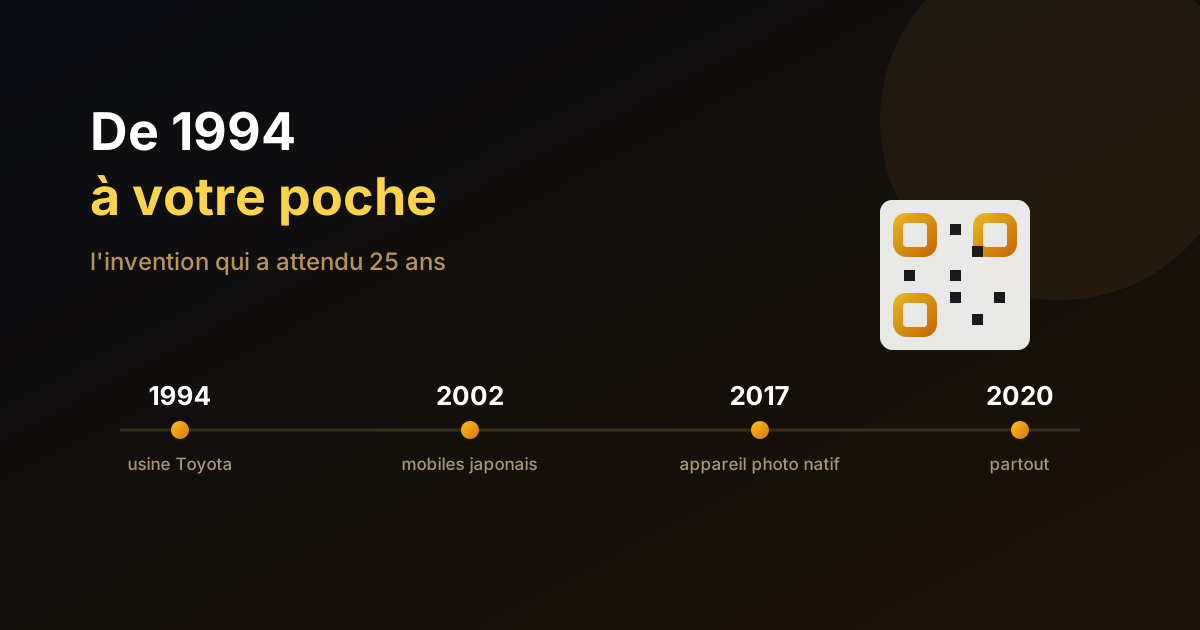
The QR code was invented in 1994. You probably started using it in 2020 or 2021. Do the arithmetic: the technology existed for twenty-five years without most of us ever hearing about it.
Twenty-five years. A full generation. Long enough for a newborn to grow up, get a degree, and start complaining about young people.
And the whole time, it worked perfectly. It was just somewhere else.
The problem on the Japanese factory floor
Rewind. Early 1990s, Japanese car industry. At Denso, a parts supplier in the Toyota group, workers had a very concrete problem.
Components were labelled with ordinary barcodes — the vertical stripes. Except a barcode holds almost nothing: about twenty characters, give or take. So to fully identify a part, you stuck several barcodes on the same label. Sometimes as many as ten.
And an operator had to scan every one of them. One at a time. Thousands of times a day.
Picture the motion. Beep. Reposition. Beep. Reposition. Beep. All day. Staff complained about fatigue, wrist pain, and how slowly the whole thing moved. What was missing wasn't technical elegance. It was a human wear-and-tear problem.
That's the problem handed to Masahiro Hara, an engineer at Denso, in 1992. With a team of two people. Two.
The idea arrived during a game of Go
This is my favourite part of the story, and it's genuine.
Hara played Go on his lunch break. Go — the board game where you place black and white stones on a grid.
He looked at the board. Black and white patterns, spread across two dimensions. And he thought: what if information were encoded like that? Not as stripes along a single line, but across a surface?
That's the whole insight. A barcode uses one dimension, so its capacity is capped by its length. A grid uses two, which multiplies capacity dramatically — from a few dozen characters to several thousand.
It seems obvious in hindsight. All good ideas do.
The real puzzle: finding the code in the mess
Encoding data on a grid wasn't the hard part. The hard part was reading speed.
A scanner sweeping across a label sees noise: letters, logos, oil stains, reflections. How do you make it instantly identify where the code starts, where it ends, and which way up it is?
The answer is the three big squares in the corners. You've looked at them during every scan you've ever done without thinking about them once.
They're position markers. Three points are enough to establish location, orientation and tilt. It doesn't matter whether you're holding your phone sideways, upside down, or at an angle — the reader always finds its bearings.
And those squares weren't drawn arbitrarily. The team analysed enormous quantities of printed material — labels, magazines, industrial documents — hunting for the ratio of black to white areas that occurs least often in the real world. They found a proportion that almost never appears anywhere else, and built the markers around it.
That's why a scanner never mistakes a QR code for a logo or a photograph. They gave it a statistically improbable signature.
I love that kind of solution. It isn't brute force. It's cunning.
The decision I still find hard to believe
The code was finished in 1994. They called it the QR Code — for Quick Response, because read speed was the obsession of the entire project.
Denso Wave filed a patent.
And then did something very few companies would do: they chose not to charge for it. The specification was published, and use was free and open to everyone. Denso Wave kept the patent but waived any royalties on it.
Take a second with that.
Today, billions of QR codes are scanned. Payments across China, restaurant menus, boarding passes, product labels, ad campaigns. An entire industry was built on top of it — including the services that sell you monthly subscriptions.
Denso Wave has never taken a cent from any of that.
And that is precisely why the format won. A paid standard runs into free competitors, fragments, and dies. A free standard becomes universal. Hara understood that before almost anyone: he wanted his code to be used, not to be profitable.
The format you'll scan this morning exists because a Japanese engineer and his employer decided, thirty years ago, to give it away.
The twenty-five years in the wilderness
So why the long wait?
Because the reader was missing.
Factories had industrial scanners. The general public had nothing. You needed a camera in every pocket, paired with software that could decode — and for a long time, that simply didn't exist.
The first compatible Japanese handsets appeared in the early 2000s, and QR codes became ordinary in Japan well before anywhere else. Everywhere else, you had to install a dedicated app. You might remember that era: "download a QR reader", and nobody ever did.
The real tipping point came when phones' native cameras learned to read codes without an app. iOS built it in around 2017; Android followed. The friction vanished overnight.
Then 2020 happened. Contactless menus, health passes, ticketing, check-ins. Within months, a technology from 1994 became a daily reflex for billions of people.
An invention that waits a quarter century for its moment, then explodes in a single quarter. There's something genuinely vertiginous about that.
Why a square, and not a circle
A question I wondered about for years without quite asking: why a square? Why not a circle, a hexagon, something prettier?
The answer comes down to how a sensor sees the world.
A digital camera is itself a grid — millions of tiny squares, the pixels, arranged in rows and columns. Encoding information on a square grid means speaking the sensor's native language. Every module of the code lands cleanly on pixels, with no ambiguous grey zone to interpret.
A circular pattern would force the reader to guess at edges, round things off, calculate. More computation, slower, more errors. And the project was called Quick Response. Speed came before aesthetics, and the square was the fastest option.
There's a printing argument too. A 1990s factory printed with dot-matrix printers, which are themselves organised as a grid. A square prints crisply. A curve bleeds. Once again, the constraints of physical reality dictated the shape.
What I find beautiful is that none of it is arbitrary. Every decision answers a physical limitation of its era. The QR code wasn't designed so much as solved — like an equation whose answer turns out to be that familiar square you scan without thinking.
What happened to the code after 1994
The version you scan today is essentially the 1994 design, which is remarkable in itself. But Denso Wave kept developing variants, and most people have never heard of any of them.
The forty versions. The standard defines sizes from version 1 (21×21 modules) up to version 40 (177×177). Bigger versions hold more data — a version 40 code at the highest capacity holds several thousand characters. Your generator picks the smallest version that fits your content, which is why encoding less produces a visibly simpler pattern.
Micro QR. A compact variant for situations where there genuinely isn't room — circuit boards, tiny components. It uses a single finder pattern instead of three, trading some robustness for footprint.
iQR. A rectangular variant with higher density, designed for surfaces where a square doesn't fit, like a narrow cable label.
SQRC. A version with a private, readable-only-with-the-right-key data section alongside the public part. Two payloads in one code.
Frame QR. A version with a deliberate canvas area in the middle, intended for imagery — an official answer to the thing everyone was already doing badly by pasting logos over standard codes.
Almost none of these caught on outside industrial niches. The plain model 2 QR code won everywhere, for the same reason it won in the first place: it's the one every device already reads. A better format that needs special support loses to a good-enough format that works everywhere. That lesson keeps repeating across the history of technology, and people keep having to relearn it.
The format was standardised internationally as ISO/IEC 18004 in 2000, which is what made it safe for anyone to build on.
The formats that lost
QR codes weren't the only two-dimensional barcode. Several rivals were technically excellent and are still in use — you've probably scanned them without noticing.
Data Matrix is smaller than a QR code at equivalent data, which is why it dominates electronics and pharmaceutical marking where space is measured in millimetres.
PDF417 is the stacked format on the back of many driving licences and on older boarding passes. High capacity, but physically wide and awkward.
Aztec needs no quiet zone, which makes it attractive on cramped tickets — it's common on European rail tickets displayed on phone screens.
So why did QR win the consumer world? Three reasons, and only one is technical. It was free. Its three finder patterns make it readable at odd angles by a handheld camera, which matters enormously when the scanner is a person waving a phone rather than a fixed industrial reader. And it arrived in Japan early enough that phone makers built support in before anyone else had settled on an alternative.
Being free and being first, in that order.
What this story teaches me
Three things stay with me.
A good idea isn't enough. The QR code was excellent in 1994 — better engineered than most of what existed. What it lacked was twenty-five years of infrastructure. A technology that "doesn't work" is sometimes just a technology that's early.
Giving things away can be the best strategy. Denso Wave's unmonetised patent created vastly more value — including for Denso Wave, whose industrial scanners sell everywhere — than a toll booth ever would have.
Constraints manufacture good solutions. The three finder squares don't exist because they looked nice. They exist because the thing had to be read fast, in a dirty factory, with 1994 hardware. That constraint produced an elegance no comfortable brief would ever have generated.
One last detail for the road. "QR Code" is a registered trademark of Denso Wave. You're free to use the technology, but the name belongs to them. It might be the only piece of this they kept for themselves.
Which seems fair enough.
And Masahiro Hara?
This story rarely ends with its author, so let's do that.
He didn't become a billionaire. He didn't found a startup or spend twenty years on magazine covers. He stayed an engineer, at the same employer, working on other codes and other problems while his invention quietly took over the planet.
In the few interviews he's given, one note keeps recurring: pride, yes, but tinged with a kind of bemusement. He designed the QR code for a factory. Watching it pay for coffee, validate a train ticket or display a menu is slightly beyond what he had in mind — and he says so with real humility.
He's also admitted to a mild regret: the code could have been more robust, better protected against certain kinds of misuse, if he'd had more time. Thirty years on, he still thinks about improving it. Maybe that's the truest portrait of an engineer — someone who invented an object used billions of times a day, and still looks at what could have been done better.
There's a lesson in there for anyone who wants it. Technologies that last are almost never the work of people chasing glory. They're honest solutions to real problems, handed to the world by people who then moved on to something else.
Next time you scan a code — within ten minutes, probably — you'll know it came from a Go board, a Toyota assembly line, and an engineer who chose to give his idea away rather than sell it.
Not bad for a small black-and-white square.
Sources: DENSO WAVE — history of the QR Code, DENSO WAVE — technical origins, Japan Patent Office