By the VixQR team · published on · 9 min read
QR Code or NFC: Which One to Actually Choose (An Opinionated Guide)
NFC or QR code for your cards, posters and products? Cost, compatibility, range, security: the honest comparison and the cases where each one clearly wins.
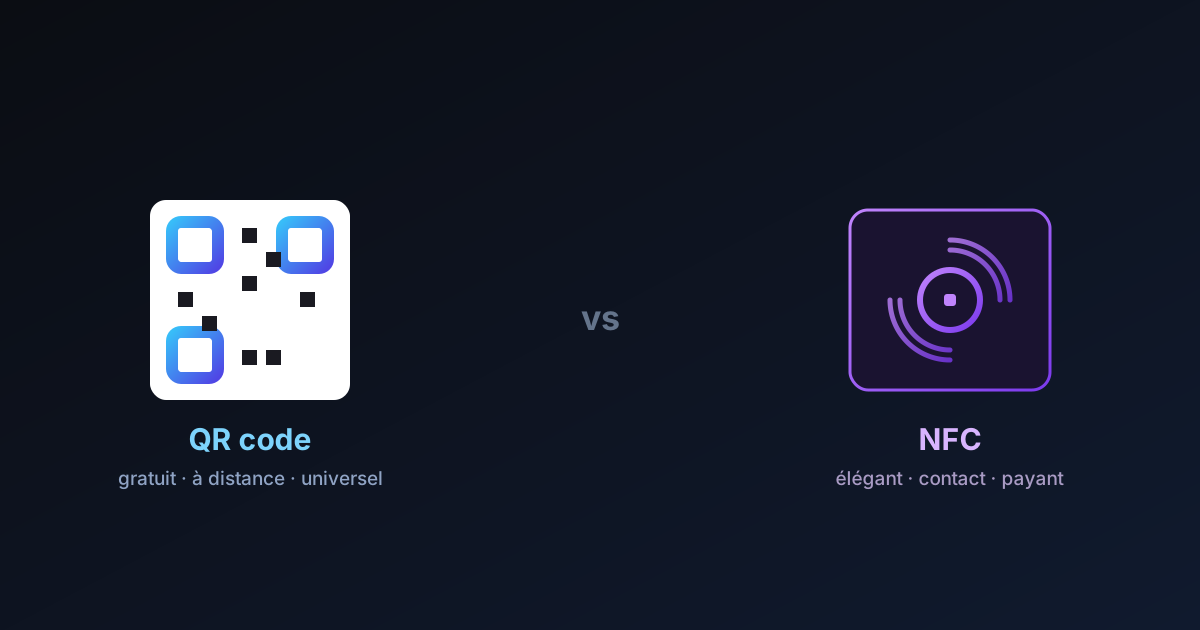
Every time someone shows me their NFC business card, they make the same face.
That small proud smile. The theatrical little move to bring the card near the phone. And then the half-second of suspense where nobody yet knows whether it's going to work.
Sometimes it works. It's genuinely impressive, I'll give it that.
Sometimes you have to try again, hunt for the right spot on the back of the phone, and the magic moment turns into a shared micro-awkwardness.
That contrast sums up the whole debate rather well.
Two very different ways to transmit three lines of text
A QR code is visual and passive. A printed pattern, read at a distance by a camera. It consumes nothing, contains no electronics, and never breaks. It's ink on paper.
NFC — Near Field Communication — is electronic. A tiny chip with an antenna, powered by the magnetic field of the phone brought near it. No battery either, but a real component, with a lifespan and a fragility.
Both ultimately carry the same thing: a link, a contact, some text. The difference is entirely in the gesture and the constraints.
What NFC genuinely does better
The gesture is more elegant. Tap, done. No camera to open, no framing, no "hang on, let me get a better angle". On a premium business card, the effect is undeniable.
It works in the dark. A QR code in a dim bar, on a badly lit lectern, is a gamble. NFC is completely indifferent to lighting.
It's invisible. No black-and-white square to work into the layout. For an object where design carries weight — an event wristband, a premium card, luxury packaging — the absence of visible marking is a real argument.
It can be rewritten. A rewritable NFC tag changes its contents from an app, with nothing to reprint.
On those four points NFC wins clearly. I'm not going to pretend otherwise.
Where it falls apart
Cost. A QR code costs nothing. You add it to an existing print file; it's ink. An NFC tag costs anywhere from a few tens of cents to a few euros each, and it has to be applied or embedded.
Across five hundred flyers, that changes the equation entirely. Across fifty premium business cards, it's negligible.
Compatibility. This is the most important point and the most misunderstood.
Every smartphone sold today can read a QR code. Every single one, no exceptions, with the native camera, with no configuration.
NFC is more nuanced. The hardware is present on most recent phones, but it can be switched off in settings, or restricted to contactless payment depending on the model and OS version. On budget ranges it's sometimes simply absent.
There's history here too. iPhones only gained app-based NFC tag reading with iOS 11, and background reading — where you just hold the phone near a tag with no app open — arrived later still, on newer hardware. Anyone holding an older device may have a phone that technically has NFC and still won't do what you're expecting.
Net result: with a QR code, it works for everyone. With NFC, it works for a lot of people. Those are not the same promise when you're printing a poster aimed at thousands of passers-by.
Range. NFC demands near-physical contact — a few centimetres. That instantly rules out the poster in the metro, the shop window, the TV screen, the sign on a wall, the flyer photographed from across a room. A QR code scans through glass. An NFC tag does not.
Finding the sweet spot. The NFC antenna sits in a different place on different phones — sometimes at the top of the back, sometimes centred. Hence the small hunting dance everyone has performed at least once.
Fragility. A chip breaks. It copes badly with folding, water and heat. A printed QR code survives whatever the paper survives — and if it gets slightly damaged, error correction rescues it. There's something almost poetic about it: the old analogue medium is more robust than the electronic component.
Data capacity. Common NFC tags hold modest amounts — typical NTAG chips range from around 140 bytes to roughly 800 bytes of usable data. That's fine for a URL or a contact record, which is what almost everyone uses them for, but it's not the open-ended capacity people sometimes assume. A QR code, incidentally, comfortably beats that at printed sizes.
The security question, which everyone gets backwards
People regularly assure me that NFC is "more secure". That's wrong, and the opposite is closer to the truth.
A QR code can be hijacked with a sticker placed over it. That's the main risk and it's entirely real. But you see the link before anything opens: your phone displays the address and asks you to confirm. You keep a checkpoint.
With NFC there's nothing to look at. No visual element tells you what the chip contains, or whether someone has stuck another tag on top of the original — which is trivial to do, precisely because the chip is invisible.
Phones generally show a confirmation before opening an NFC link, and that helps. But the user had no way to be suspicious before the gesture.
So no: NFC isn't more secure. It's just less visible, which is a different thing entirely.
The match across five real situations
Principles are fine. Here's how it plays out where the question actually comes up.
A business card. Close call, and the one case where I'd lean NFC — on condition that you add a QR code on the back. The contactless gesture does make an impression in a meeting, but you cannot afford to lose a contact because a phone refused to cooperate. Both together, and you're covered.
A street poster. QR code, no hesitation. NFC is physically out of the game: nobody is pressing their phone against a panel three metres up behind glass. Reading at a distance isn't a detail here, it's the entire function.
A restaurant menu. QR code. You're printing multiple table tents, cost matters, and you want it to work for the table of eight with eight different phones. An NFC tag per table tent adds up fast for zero benefit.
An event badge. Depends on volume. Fifty reusable VIP badges? NFC is lovely and the cost justifies itself. Two thousand disposable badges for a trade show? Printed QR codes, obviously — you're not throwing two thousand chips in the bin that evening.
A product on a shelf. QR code, almost always. The customer scans from a distance without touching, through the packaging, sometimes through a fridge door. And across tens of thousands of units, the per-chip surcharge becomes a budget line of its own.
Notice the pattern? Whenever there's volume or distance, the QR code wins. Whenever it's a single object, held in the hand, where cost doesn't matter, NFC takes the lead. It's actually quite easy to settle once you ask the real question: how many copies, and at what distance?
The summary table
| QR code | NFC | |
|---|---|---|
| Unit cost | Zero | Cents to a few euros |
| Works on every phone | Yes | Mostly |
| Range | Metres | 1–4 cm |
| Works in darkness | Poorly | Perfectly |
| Visible on the design | Yes | No |
| Survives folding, water, heat | Yes | Poorly |
| Content changeable after production | Only via the destination URL | Yes, rewritable |
| User can inspect before opening | Yes | No |
The procurement reality nobody mentions
If you've never actually bought and deployed NFC tags, there are practical details that change the calculation considerably.
Somebody has to encode them. Blank tags arrive blank. You write them with a phone app, one tag at a time, by holding the phone against each one. That's fine for fifty business cards. Encoding five hundred tags is a genuine afternoon of repetitive work, and encoding five thousand means paying for pre-programmed tags — which costs more and locks the content before you've finished designing it.
A QR code, by contrast, is applied by the printer as part of a file you were sending anyway. Marginal effort: zero.
Lock or don't lock — and understand the trade. NFC tags can be write-locked permanently. Locked means nobody can change it, including you. Unlocked means the content stays editable — and anyone with a phone can overwrite your tag.
That second point is a real security issue that rarely gets raised. An unlocked NFC tag on a public surface — a poster, a table, a shelf edge — can be silently rewritten by any passer-by in about three seconds, with no visible trace. At least a QR sticker placed over another is physically visible if someone looks. Public-facing tags should be locked, which means accepting that they're now as permanent as print.
Metal changes everything. Standard tags don't work on metal surfaces — the metal detunes the antenna. You need on-metal tags with ferrite shielding, which cost more and are thicker. If you're tagging equipment, machinery or metal packaging, budget for this from the start rather than discovering it after the first order arrives.
Expect a failure rate. Cheap tags fail out of the box at rates you won't accept in a premium context, and they fail after handling, folding or heat. Order more than you need and test every one before it goes to a customer.
None of this makes NFC a bad choice. It makes it a choice with an operational tail that a QR code simply doesn't have.
My take, straight
Choose NFC when:
- you're producing few units and unit cost doesn't matter;
- the object is held in the hand — business card, badge, wristband, premium product tag;
- the "wow" is part of the message;
- the lighting is inherently bad.
Choose a QR code when:
- you're printing at volume;
- the medium is seen at a distance — poster, window, screen, wall, retail packaging;
- you want it to work for everyone, without exception;
- you want it still working in ten years with nothing to maintain;
- your budget is zero.
And if you can't decide? Use both.
That's what well-designed business cards do: NFC chip for the elegant gesture face to face, small printed QR code on the back for the colleague whose phone won't play along. It costs one more print element, and you stop losing people.
An NFC-only card is a bet on the other person's phone. NFC plus a QR code is a certainty.
One thing both share
Whichever you pick, the same rule applies: point it at a URL you control.
An NFC tag that resolves to a platform you don't own has exactly the same failure mode as a rented dynamic QR code — the day that service disappears, every physical object you produced becomes inert. Rewritable tags help only if you still physically possess the objects, which you don't once they're in five hundred pockets.
The medium is the interesting argument. The destination is the one that determines whether your work survives.
What I actually use
QR codes, more or less everywhere. Not out of ideological conviction, but out of admitted laziness: it works on everything, costs nothing, doesn't break.
That said, if I were ordering business cards for a trade show, I'd get NFC. The gesture creates a moment of conversation, and in that specific context, that's exactly what you're after.
With a QR code on the back. Because across fifty meetings there will always be five where the chip doesn't take, and I'm not losing five contacts to preserve an elegance.
That might be the real lesson of this comparison: the technology that wins is the one that fails least often, not the one that impresses most.
You can generate your contact QR code here — free, and it will work on absolutely every phone.
Including the one belonging to the person whose NFC has been switched off since 2019 and who has no idea.